Ariana Afghan Airlines: What You Really Need to Know Before Booking a Flight
Founded in 1955 as Afghanistan's flag carrier, Ariana Afghan Airlines is state-owned and has its main hub at Kabul airport. It links the Afghan capital with regional destinations in Central and South Asia and with a few routes to the Gulf, but remains cut off from direct links with Europe because of the flight ban imposed by the EU.
History and positioning
Ariana Afghan Airlines was founded in 1955 as the flag carrier of the Kingdom of Afghanistan and today remains, despite the changes of government the country has gone through, a state-owned company. It is an increasingly rare case on this scale: most comparable flag carriers around the world have been privatized or listed in recent decades, while Ariana has stayed firmly in the hands of the Afghan state through every political transition. Each change of government in Kabul has historically meant service interruptions, management changes and difficulties in obtaining spare parts, rather than growth investment, and the airline has had to rebuild relationships with international maintenance suppliers several times after periods of diplomatic isolation. Today it positions itself as the only Afghan carrier with a regular, if limited, international network, while domestic traffic is contested with private operators such as Kam Air, created precisely to fill the gaps left by the state airline. The airline's management has also had to deal with the consequences of the freezing of Afghan state assets abroad after 2021, a factor that has further complicated the purchase of spare parts and maintenance services abroad.
The fleet
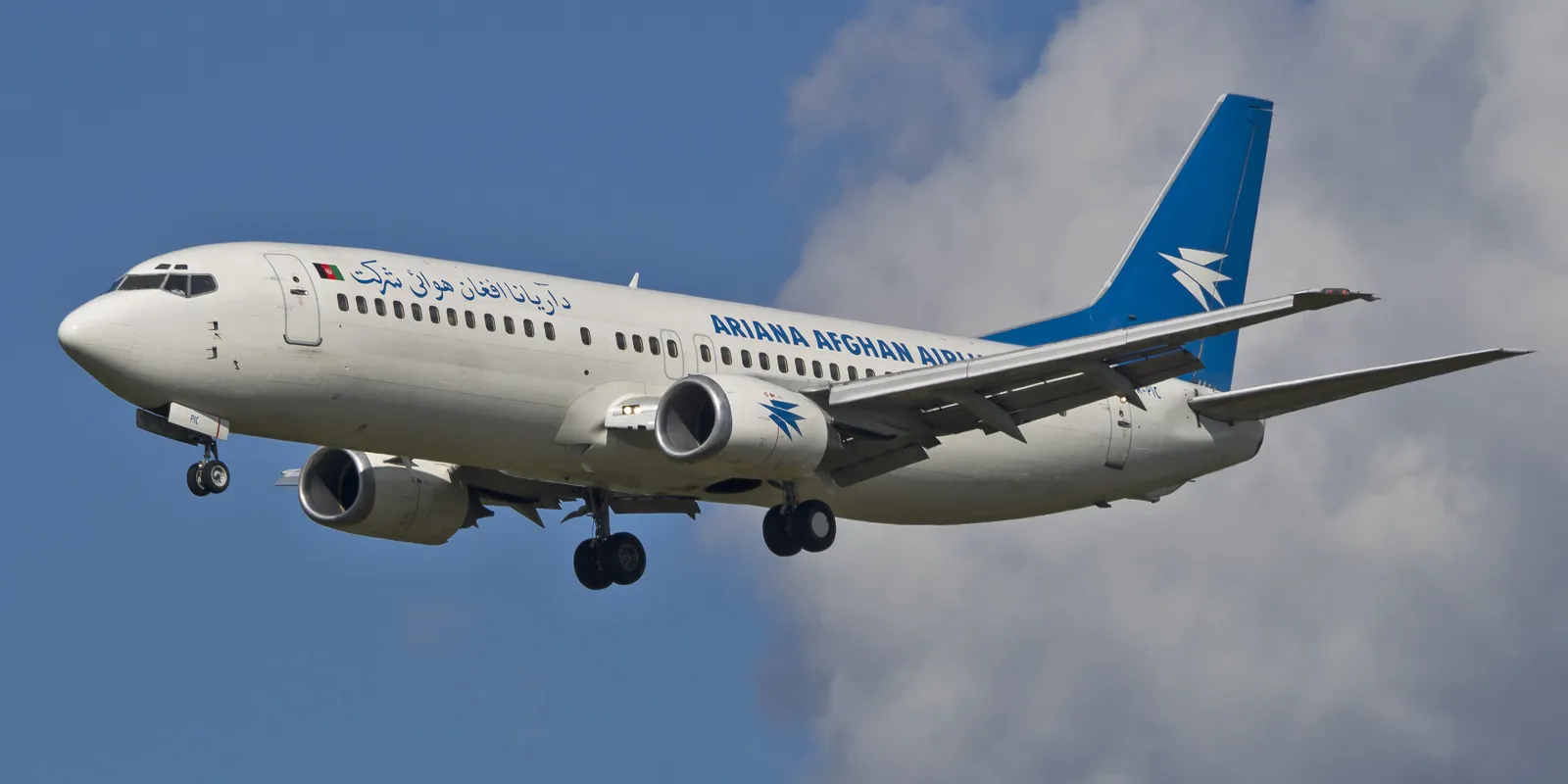
The operating fleet is reduced to two Airbus A310-300s and a couple of Boeing 737-400/500s, all aircraft long out of production and kept in service well beyond the average age of most comparable flag-carrier fleets in the region. Finding spare parts for models no longer actively supported by the manufacturers is one of the airline's less visible but most constant operational challenges. For the link with Germany, the only European route left in its network, Ariana uses a leased Airbus A321 registered in France: a technical solution that allows it to operate under European aviation oversight, thus bypassing, at least on this single route, the ban directly affecting Afghan-registered carriers. Leasing additional aircraft from other regional operators remains an option the airline is considering to strengthen capacity in peak periods, such as the seasonal returns of the Afghan diaspora.
Routes and network
Since 2010 the European Union has banned all carriers registered in Afghanistan from entering EU airspace, because Afghan safety rules fail to meet the international oversight standards required by ICAO. As a result, Ariana's own network is concentrated on Central Asia (Dushanbe, Mashhad), South Asia (Delhi, Islamabad) and a few Gulf destinations such as Dubai, in addition to the domestic links between Kabul, Herat, Mazar-i-Sharif and Kandahar, which remain the operational heart of the airline given the scarcity of overland alternatives in a country with such rugged terrain. The only link to Europe, Germany, relies on the leased-aircraft arrangement described above, and remains an exception rather than a true European network. Demand on the routes to South Asia remains strong, also thanks to the flows of Afghan workers and students traveling to Delhi and Islamabad for study or for medical care not available at home.
Fares and baggage
The main purchase channel remains local travel agencies or the airline's official website, while the Afghan banking system, subject to international limits on payments since 2021, complicates direct purchase with foreign-issued credit cards for those booking from Europe or the United States. The fare is generally inclusive of one checked bag, in line with the traditional flag-carrier model rather than a low-cost scheme charging for individual extras.
On board and service
The cabin product faithfully reflects the age of the fleet: no individual digital entertainment, simple meals on the longer routes and an economy-only configuration on most regional flights, without the business-class segmentation that characterizes many flag carriers of comparable size. Cabin crew are described as friendly on the shorter routes, but with limited resources to handle operational problems or special requests, partly because of a corporate structure operating on much smaller budgets than state carriers in other regions.
What passengers say
Independent reviews of Ariana are scarce compared with the big regional carriers, a reflection of the small base of international passengers who review it online compared with those who fly out of necessity on domestic or diplomatic routes. People who review the airline online tend to do so mostly in Dari or Pashto on regional platforms, which further reduces the visibility of passenger opinions on the most widely used international portals.
- Staff perceived as helpful on the shorter regional legs.
- Competitive prices on the few direct routes available, often with no convenient alternatives.
- Useful domestic connections in a country with limited ground transport infrastructure.
- A fleet nonetheless kept airworthy despite the age of the aircraft.
- Limited information in case of schedule changes or cancellation.
- Basic onboard comfort, consistent with a fleet that has not received new aircraft in years.
- An international network reduced to a few regional destinations, with no direct links to Western Europe or North America.
- Online payment difficulties for those booking with foreign-issued cards, due to Afghan banking restrictions.
Ariana is a realistic choice for anyone who needs to reach Afghanistan or certain Central Asian cities with no direct alternatives, not for those looking for a modern onboard product or a guarantee that the schedule will be kept. If your travel plan involves a tight connection, it is better to avoid it: schedule changes are not rare. Before booking, always check the latest travel advisories for Afghanistan and leave a generous margin for possible delays in Kabul.
You might also like...

Adams Field: where to stay, areas and recommended hotels
Azerbaijan Airlines: What Passengers Say About AZAL Comfort and Punctuality

When it's worth booking a flight

Kuwait International Airport: where to stay, areas and recommended hotels
Aeroitalia: The ITA Airways Lawsuit, the Growing Fleet and What to Expect On Board