Etihad Airways: How the Abu Dhabi Carrier Returned to Growth After the Alliance Crisis
Etihad Airways was founded in 2003 and is controlled by the government of Abu Dhabi, with a single hub at Abu Dhabi International Airport. After a decade marked by a strategy of equity stakes in foreign carriers that later foundered, the airline went through a phase of deep downsizing before returning, in recent years, to steady growth based on its own network rather than on equity alliances.
History and positioning
Between 2014 and 2017 Etihad acquired stakes in several foreign carriers, including Alitalia and airberlin, with the aim of building a global alliance based on direct shareholdings. The strategy proved unsustainable when several partners ran into crisis almost simultaneously, forcing Etihad into heavy write-downs and a drastic overhaul of its business model. Since then the airline has focused on its own network and direct financial sustainability, a path that has begun to deliver results in recent years.
The fleet in strong expansion
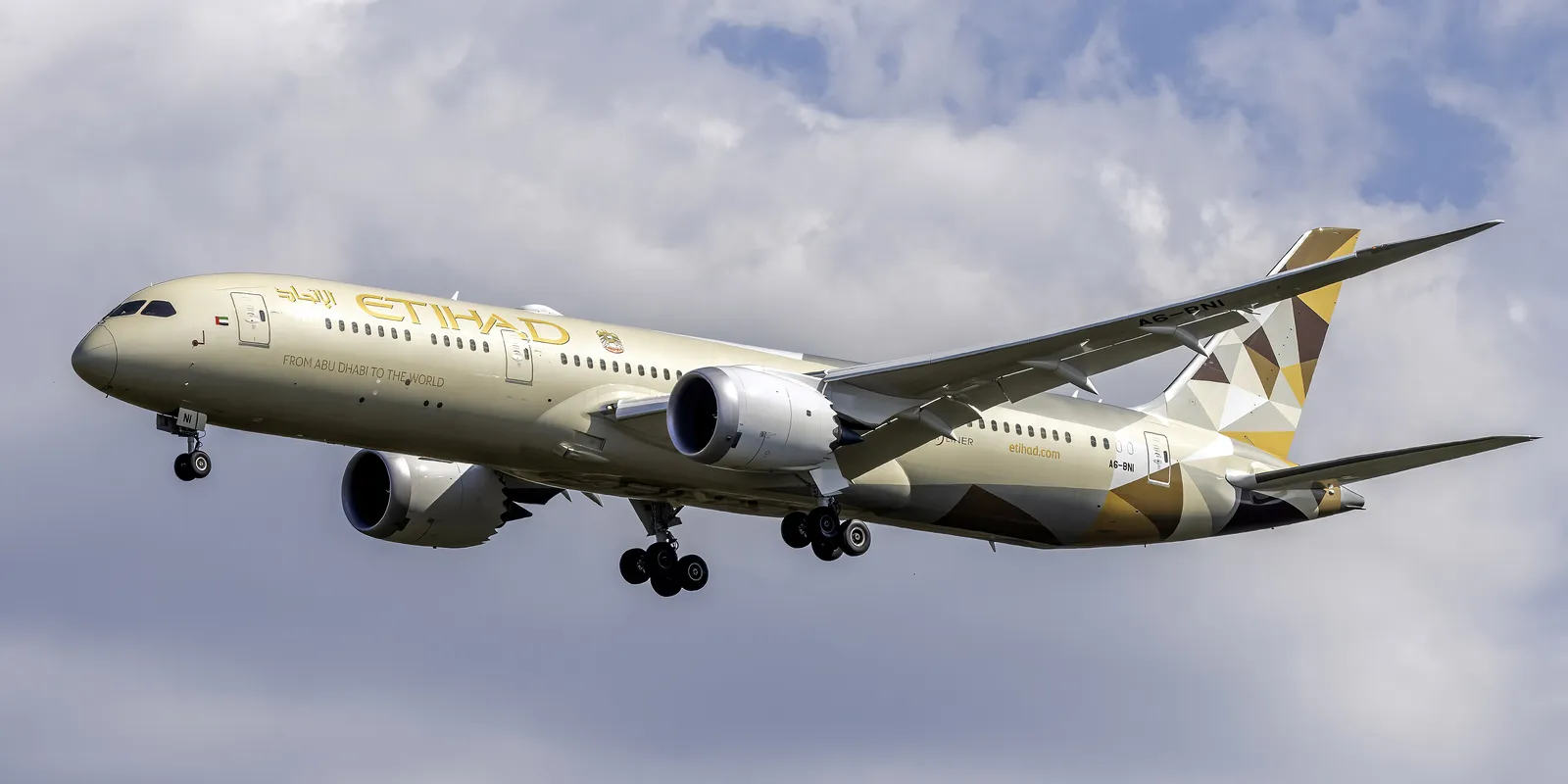
At the end of 2025 the fleet reached about 117 aircraft, an increase of 29 units in just twelve months, the fastest growth in the airline's history. The widebody component includes 37 Boeing 787-9 and 10 787-10 aircraft, along with 9 Airbus A350-1000, plus a share of A380, A320 and A321 aircraft still in service.
Routes and network
From Abu Dhabi the network is expanding across several continents in parallel with the arrival of the new aircraft, at a growth pace that the airline itself has called a record for 2025, concentrated mainly on long-haul routes to Asia, Europe and North America.
On board and service
The premium cabins on the 787s and the A380 have been repeatedly cited by Skytrax as among the best in their category, a judgment that concerns in particular the comfort of the Business and First suites on the newest widebodies.
What passengers say
In the 2025 Skytrax ranking Etihad placed 26th globally, seven places lower than 19th in 2024, remaining behind the Gulf competitors Qatar Airways and Emirates. The verdict on the cabins nevertheless remains positive: Skytrax described those of the 787 and the A380 as among the best in their category, a contrast that suggests a solid onboard product accompanied by an overall positioning still being consolidated.
Etihad Airways suits those looking for a high-level Business or First product on long-haul routes in full expansion, also taking advantage of fares that are often more competitive than those of its Gulf rivals during this growth phase. It is a less suitable choice for anyone who gives absolute priority to network breadth over product quality, because the network remains smaller than that of the largest regional competitors. During the phase of strong fleet growth, always check the aircraft type assigned to your route before choosing your cabin, because the onboard product changes significantly between the newest models and those on their way out of the fleet.
You might also like...
People's Viennaline: The Tiny Austro-Swiss Airline and the Routes It Really Flies

São Tomé International Airport: where to stay, areas and recommended hotels

Bahamasair: The ATR and Boeing Fleet of the Bahamas' Flag Carrier

Menara Airport: where to stay, areas and recommended hotels

Expiring passport: can you still travel?