Virgin Atlantic in 2026: An All-Widebody Fleet, the Weight of Heathrow and What Passengers Say About Upper Class
Virgin Atlantic was founded in 1984 by Richard Branson and has built its identity on a long-haul operation that is exclusively transatlantic and long-term leisure, with its main base at London Heathrow and a second hub at Manchester used for services to New York, Orlando and Atlanta. Since 2013 the Delta Air Lines group has held a significant stake in the capital, a link reflected in the commercial partnership and in the SkyTeam alliance, which Virgin joined precisely thanks to this relationship.
History and positioning
Born as a challenge to traditional carriers on the London-New York route, Virgin Atlantic has maintained a premium-leisure positioning for decades, relying on the Upper Class cabin as its distinguishing feature against both legacy competitors and long-haul low-cost carriers. Delta's entry into the capital has strengthened its presence on the North Atlantic, where the two airlines together with the SkyTeam partners control about 24% of total capacity from Heathrow.
The fleet
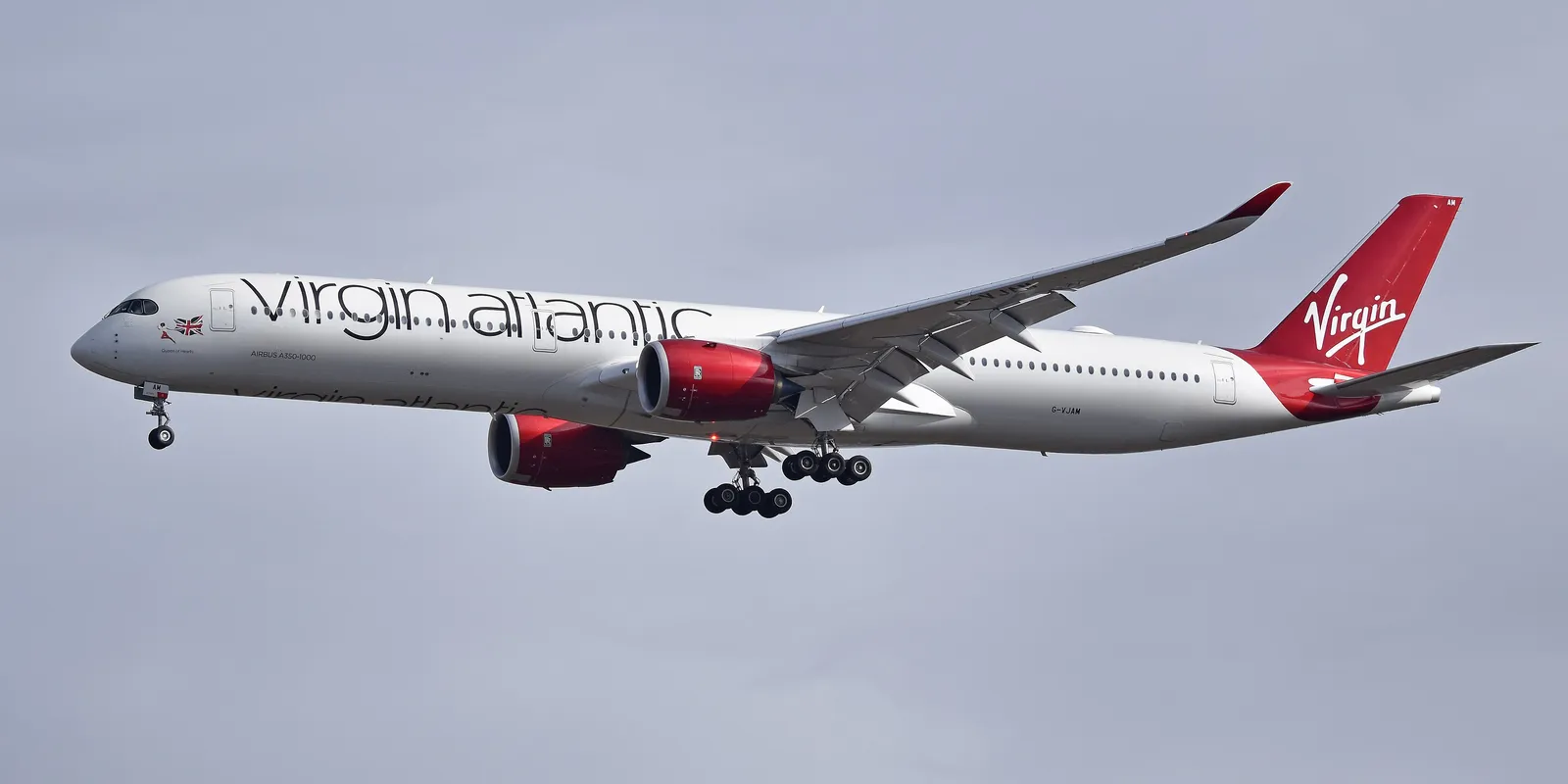
Unlike most competitors, the fleet consists exclusively of twin-engine widebody aircraft: Boeing 787-9, Airbus A350-1000 and A330-900neo, with a declining number of older A330-300s still in service. About 74% of the fleet already belongs to the most recent generation, with an average age under seven years, among the lowest in the industry on long-haul.
Routes and network
The network remains concentrated on the North Atlantic, with Manchester used as a second departure point to New York JFK, Orlando and Atlanta, as well as connections to Toronto, Cancún and several Caribbean destinations. The size of the network remains deliberately small compared with the large legacy carriers, in line with a strategy that favors a few high-density routes over global coverage.
On board and service
The A350-1000 flies in two distinct configurations: one with 335 seats, 44 of them in Upper Class and 56 in Premium, the other with 397 seats, 16 in Upper Class and 56 in Premium, designed for routes with greater leisure demand in Economy. The Upper Class cabin remains the brand's main differentiating element, with an onboard bar on some aircraft and a service designed to stand out from the more formal Business of the legacy carriers.
What passengers say
Online opinions particularly reward the Upper Class experience, while Economy receives ratings closer to the industry average.
- Most praised elements: the quality and atmosphere of the Upper Class cabin, the low average age of the fleet, cabin crew with an identity perceived as less rigid than at traditional carriers.
- Most contested elements: the high price of Upper Class compared with the Business of some competitors on comparable routes, a network limited to a few destinations compared with the global networks of the large groups, reduced availability of Premium Economy seats in peak periods.
Virgin Atlantic is the right choice for those who want to fly Upper Class on a direct transatlantic route from Heathrow or Manchester and appreciate a product that stands apart from traditional legacy carriers. It is less suitable for those who need a global network with many connection options, since coverage remains concentrated on the North Atlantic and a few other regions. Anyone booking Upper Class should check the specific A350 configuration assigned to the route, because the higher-density economy version reduces the space devoted to the premium cabins compared with the more balanced configuration.
You might also like...

Gatwick airport lounges: how to choose between North and South

Pdte. carlos Ibañez del Campo Airport: where to stay, areas and recommended hotels

Reims-Champagne (BA 112) Airport: where to stay, areas and recommended hotels
ITA Airways in 2026: The New Fleet, the Move to Lufthansa and What Passengers Really Say
Skymark Airlines: How the Japanese Low-Cost Carrier Rescued by ANA Flies Today