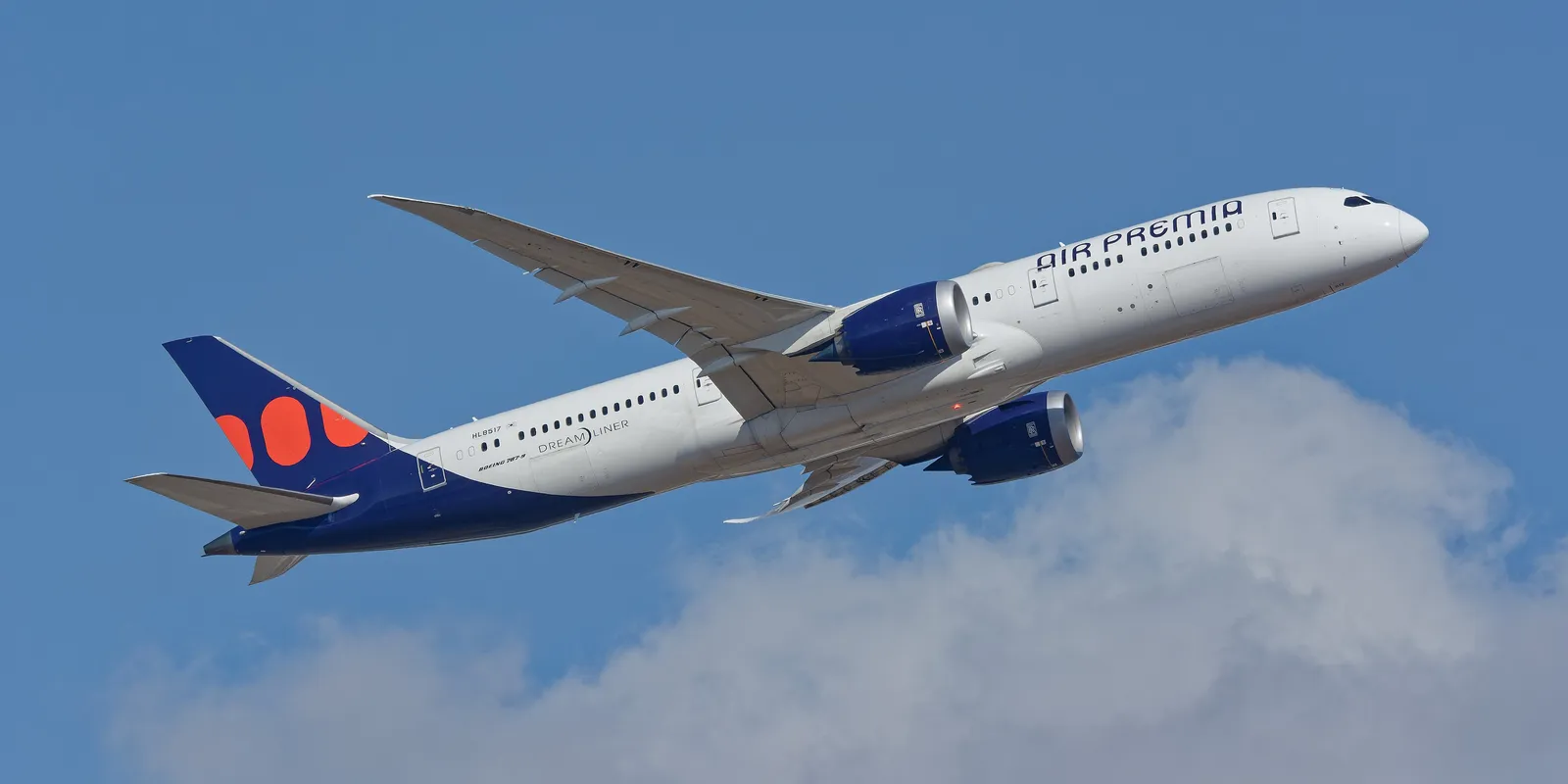
Air Premia: The Korean Airline That Flies Only Dreamliners Between Seoul and the United States
Air Premia is a South Korean airline founded in 2017 and operating since 2021, based at Incheon Airport. It presents itself as a hybrid carrier, halfway between low-cost and traditional, specializing in long-haul routes linking South Korea to the United States and Southeast Asia with a single aircraft family.
A single-type fleet
Air Premia operates exclusively Boeing 787-9 Dreamliners, a choice that simplifies maintenance and crew training and sets it apart from the competing Korean low-cost carriers, almost all based on short-haul narrowbodies. The cabin is split between Economy and a roomier Premium class, designed to attract passengers who want more space without paying the full price of full-service carriers' business class.
Routes and network
From Incheon the airline connects Los Angeles, San Francisco, New York/Newark and, from 2026, Washington Dulles on the North American side, as well as Honolulu; on the Asian side it operates to Bangkok, Da Nang, Hong Kong and Tokyo Narita. It is a network built on a limited number of high-demand destinations rather than a far-reaching one, consistent with a still relatively small fleet.
Fares and baggage
The fare model follows hybrid logic: base Economy fares are competitive against Asian full-service competitors on the same routes, but baggage allowance, seat selection and hot meal may depend on the fare purchased. The Premium class, more generous with space, is still priced between economy and the business class of traditional carriers.
What passengers say
- Reported strengths: a recent Dreamliner cabin that is uniform across the network, and a Premium class judged a good compromise of space and price on transpacific routes.
- Most cited limits: a network still small compared with the big Korean carriers, less choice of schedules in case of cancellation given the small fleet.
Air Premia is a good option if you fly between South Korea and the US West Coast and want more space than traditional economy without the price of full-service carriers' business class. It is less suitable if you need a far-reaching network with many schedule alternatives in case of unforeseen events.
Consider the Premium class if the flight exceeds ten hours: the price difference from economy remains modest compared with what full-service competitors charge for a comparable product.
You might also like...
Flight delay insurance: when it's worth getting

Ouarzazate Airport: where to stay, areas and recommended hotels

Lanseria Airport: where to stay, areas and recommended hotels
Azerbaijan Airlines: What Passengers Say About AZAL Comfort and Punctuality
Portugalia Airlines (TAP Express): The Regional Network Connecting Portugal with Embraers