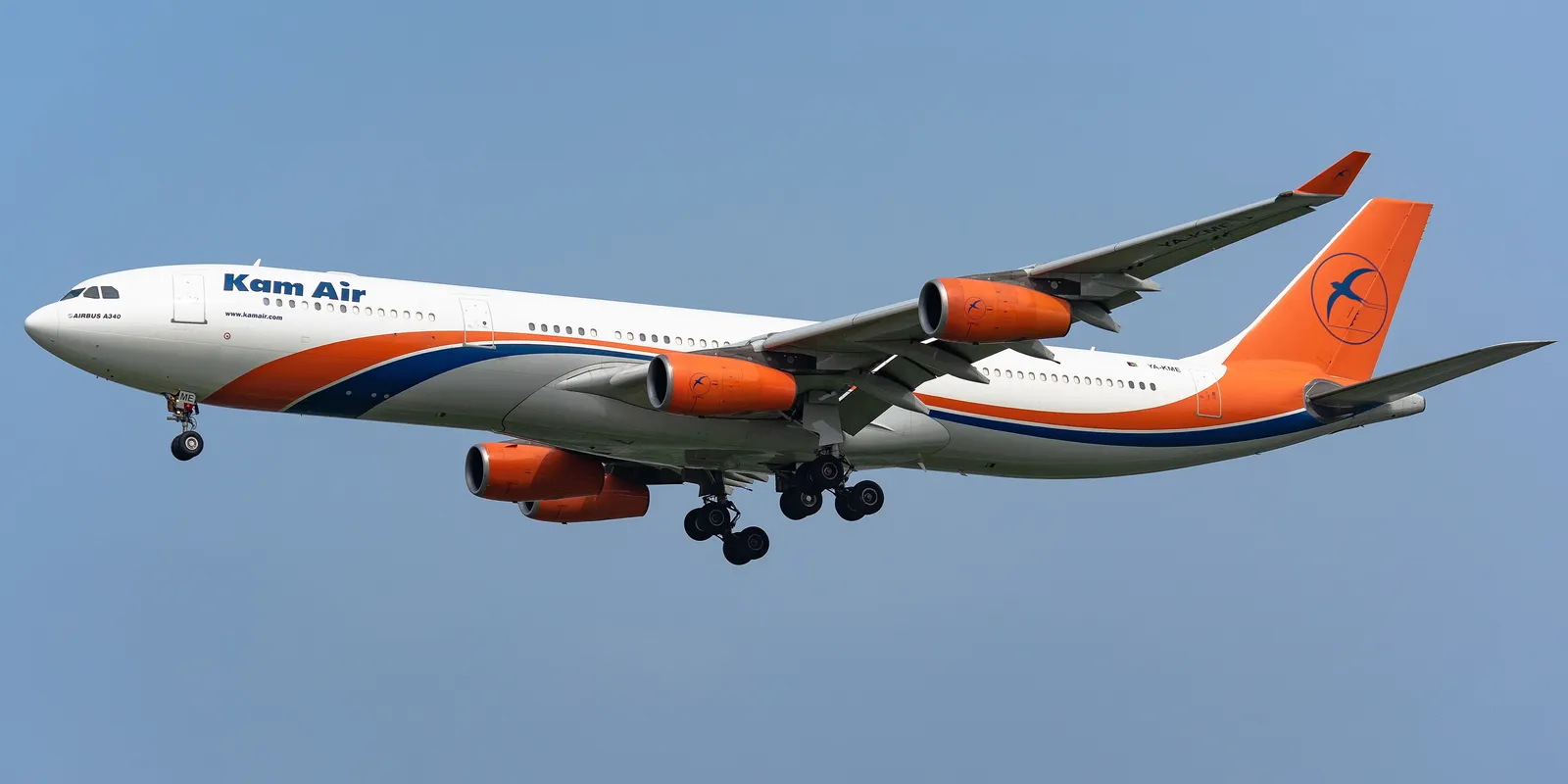
Kam Air: The Fleet and Routes of Afghanistan's Leading Private Carrier
Kam Air is Afghanistan's largest private airline, founded in 2003 and hubbed at Kabul airport. It covers the Afghan domestic network and extends onto regional routes to Central Asia, South Asia and the Persian Gulf, thus standing alongside Ariana Afghan Airlines as the main alternative for those flying within and out of the country.
History and positioning
Founded in 2003, a few years after the fall of the first Taliban regime, Kam Air is today Afghanistan's largest private airline and the main competitor of the state flag carrier Ariana Afghan Airlines. Unlike Ariana, which has always kept an almost institutional role tied to the country's various political phases, Kam Air developed as a purely commercial operator, growing on demand for Afghan domestic links and on regional routes to the main hubs of the Gulf and Central Asia, often used by those who then continue on international carriers to Europe or North America. The airline also went through delicate moments concerning the safety of its aircraft during the international withdrawal from Afghanistan in 2021, when some of its jets were temporarily moved abroad to be kept safe. Over the years the airline has also expanded its maintenance base in Kabul, partially reducing its dependence on foreign workshops for simpler interventions.
The fleet
The fleet is unusual for the size of the airline: five wide-body Airbus A340-300s, originally designed for long-haul intercontinental flying, are also used on shorter regional routes where single-aisle aircraft would normally be seen, a choice dictated more by availability on the used-aircraft leasing market than by any logic of efficiency. Alongside them are six Boeing 737-300s and one 737-500, both rather dated models no longer in production, while a Boeing 767 is currently inoperative and parked. This combination, inefficient in terms of fuel consumption, nevertheless provides flexibility on routes with variable demand and allows capacity to be reassigned between different routes with relative speed. Maintaining the A340s, complex and expensive aircraft to run, remains one of the most significant fixed costs of the airline's operating structure.
Routes and network
Kam Air operates the most extensive Afghan domestic network among the country's carriers, with links between Kabul, Herat, Kandahar, Mazar-i-Sharif and other smaller cities such as Nangarhar and Kunduz, and extends onto international routes to Central Asia (Dushanbe, Almaty), South Asia (Delhi, Islamabad) and the Gulf (Dubai, Jeddah), the latter also relevant for religious pilgrimages. It does not operate routes to Europe or North America, and has no plans to do so in the short term given the international regulatory situation. The routes to the Gulf also remain particularly important for carrying Afghan workers employed in the United Arab Emirates and Saudi Arabia.
On board and service
The cabin product remains that of a fleet that is no longer young, with no individual digital entertainment on most aircraft and no true business class on the shorter regional routes. On flights with the wide-body A340s the catering service is described as more refined than on the shorter regional flights operated with the 737s, where service is often limited to a snack and drinks, consistent with the nature of a regional scheduled link rather than a premium intercontinental flight.
Fares and baggage
Tickets are bought mainly through local travel agencies in Kabul and the main Afghan cities, as well as the airline's official website; payment with international cards remains complicated because of the banking restrictions affecting the Afghan aviation sector as a whole. The base fare generally includes a standard baggage allowance, without the pay-per-extra model typical of low-cost carriers.
What passengers say
Those who fly Kam Air on Afghan domestic legs report quick boarding times and direct service at the smaller airports, where procedures are generally less complex than at the big international hubs, while reviews of the longer international routes are more critical about how the unexpected is handled. The base of international reviewers remains small, though, with most public comments concentrated on aviation-specialist forums rather than general travel portals.
- An extensive domestic network, useful for reaching smaller Afghan cities with no convenient alternatives.
- Cabin crew generally helpful, even on the longer routes with the A340s.
- Regional links to the Gulf and Central Asia useful for onward connections on other carriers.
- Fares generally competitive on regional routes to the Gulf and Central Asia.
- Limited communication in case of gate or schedule changes on international routes.
- A dated cabin product, with neither individual entertainment nor a true regional business class.
- A mixed fleet that can mean significant differences in comfort from one flight to the next.
- A Boeing 767 currently out of service reduces the capacity available on the longer routes.
Kam Air is the most practical choice for anyone who needs to move within Afghanistan or connect to regional hubs without going through more expensive international carriers. It is not recommended for those who need tight connections or expect the service of a European airline. A useful tip: always reconfirm your flight time in the days before departure, especially on the longer regional routes.
You might also like...

Sir Grantley Adams International Airport: where to stay, areas and recommended hotels
ITA Airways in 2026: The New Fleet, the Move to Lufthansa and What Passengers Really Say

Licenciado Gustavo Díaz Ordaz International Airport: where to stay, areas and recommended hotels
Etihad Airways: How the Abu Dhabi Carrier Returned to Growth After the Alliance Crisis
What to check the night before your flight: the evening ritual
