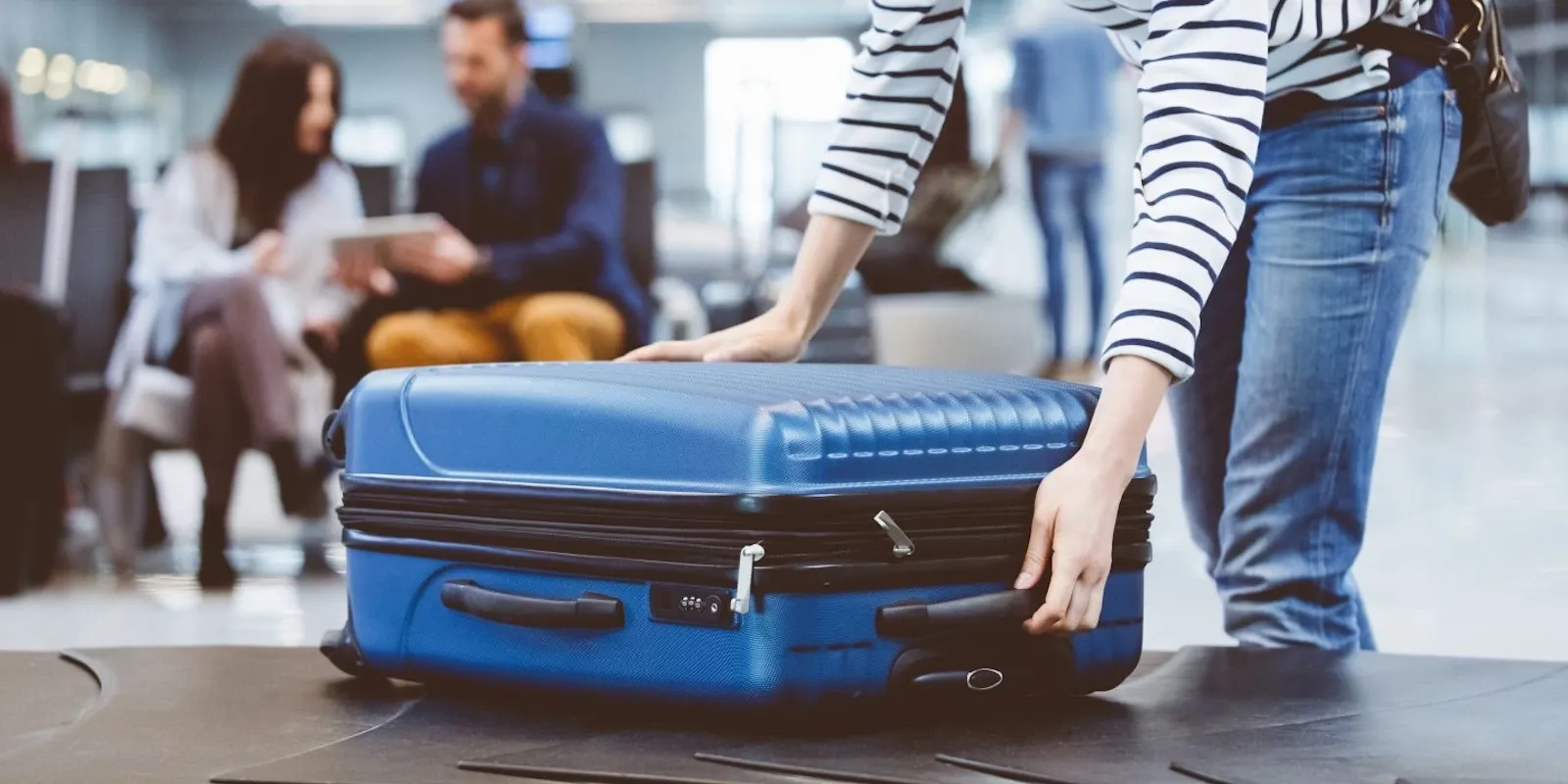
Check-in with checked luggage: what changes
Online check-in covers only the boarding pass: anyone with a suitcase to check into the hold must still go to a desk or self-service kiosk for baggage deposit, a step with its own deadline that at many airlines closes between 40 and 60 minutes before departure.
From digital check-in to baggage deposit
Anyone arriving with the boarding pass already ready on their phone does not need to redo the entire registration at the desk: just the dedicated lane for baggage deposit only, faster than the one reserved for those still completing check-in, because staff only need to check the luggage tag and weight. At many airports this step is handled by self-service kiosks: the passenger prints the tag, applies it to the suitcase and deposits it on a conveyor with integrated scale, which returns a visual confirmation if the weight is within the limits of the purchased fare.
Identifying the correct line immediately, usually marked by signs above each desk, avoids wasting time in a slower queue than necessary; those transporting oversized luggage, such as sporting equipment or musical instruments, are directed instead to a separate desk, where staff calmly manage the size and packaging checks required for transport in the hold.
Closing times and overweight: differences from online check-in
Online check-in can remain open until a few hours before departure, but baggage deposit has its own deadline and a tighter one. ITA Airways, for example, closes the baggage desk 40 minutes before departure for domestic and Schengen area flights, and 60 minutes before for other international flights: similar schemes, with minor variations, are applied by most European airlines, so it’s always worthwhile to verify the exact time listed on your booking.
If the suitcase exceeds weight or dimensions declared at the time of booking, the overweight penalty is applied directly at the desk, almost always at a higher cost than it would have cost to pay online in advance for heavier luggage. Anyone who purchased a second item must also check that each suitcase receives its own tag, a detail that staff verify automatically but which is always worth checking visually before leaving.
Special luggage: stopovers, duty-free liquids and strollers
For those with a flight with a stopover, knowing whether the luggage will be automatically transferred to the final destination avoids having to pick it up and recheck it yourself during the plane change: this is information that the desk can confirm at the time of deposit. The rules on when luggage is automatically transferred depend on the agreement between airlines and the stopover airport, so in case of doubt it’s worth asking the desk explicitly.
Liquids purchased at a duty-free during a stopover remain permitted in the cabin only if sealed in the tamper-evident bag (STEB) with the receipt visible and dated the same day: if the next flight involves a second security screening, some non-EU countries do not recognize this bag and may confiscate the purchase, so finding out beforehand avoids an unpleasant surprise.
Strollers and car seats can almost always be delivered at the aircraft door instead of at the desk, a free service that allows you to use them until the last moment in the terminal and pick them up right after disembarking, without waiting for them on the carousel with the luggage.
Always allow a margin of at least 15-20 minutes before the official closing time of the baggage deposit indicated on your booking, and ask staff to confirm verbally that your suitcase has been routed to the correct flight before leaving the desk.
You might also like...

Fiumicino lounges: which to choose before departing

How to prepare your pet for its first flight

IBEX Airlines: Who Flies the Regional Jets Between Sendai and Japan
Qantas: The Fleet, the New A350s and What Passengers Really Say

When to do online check-in for a flight
