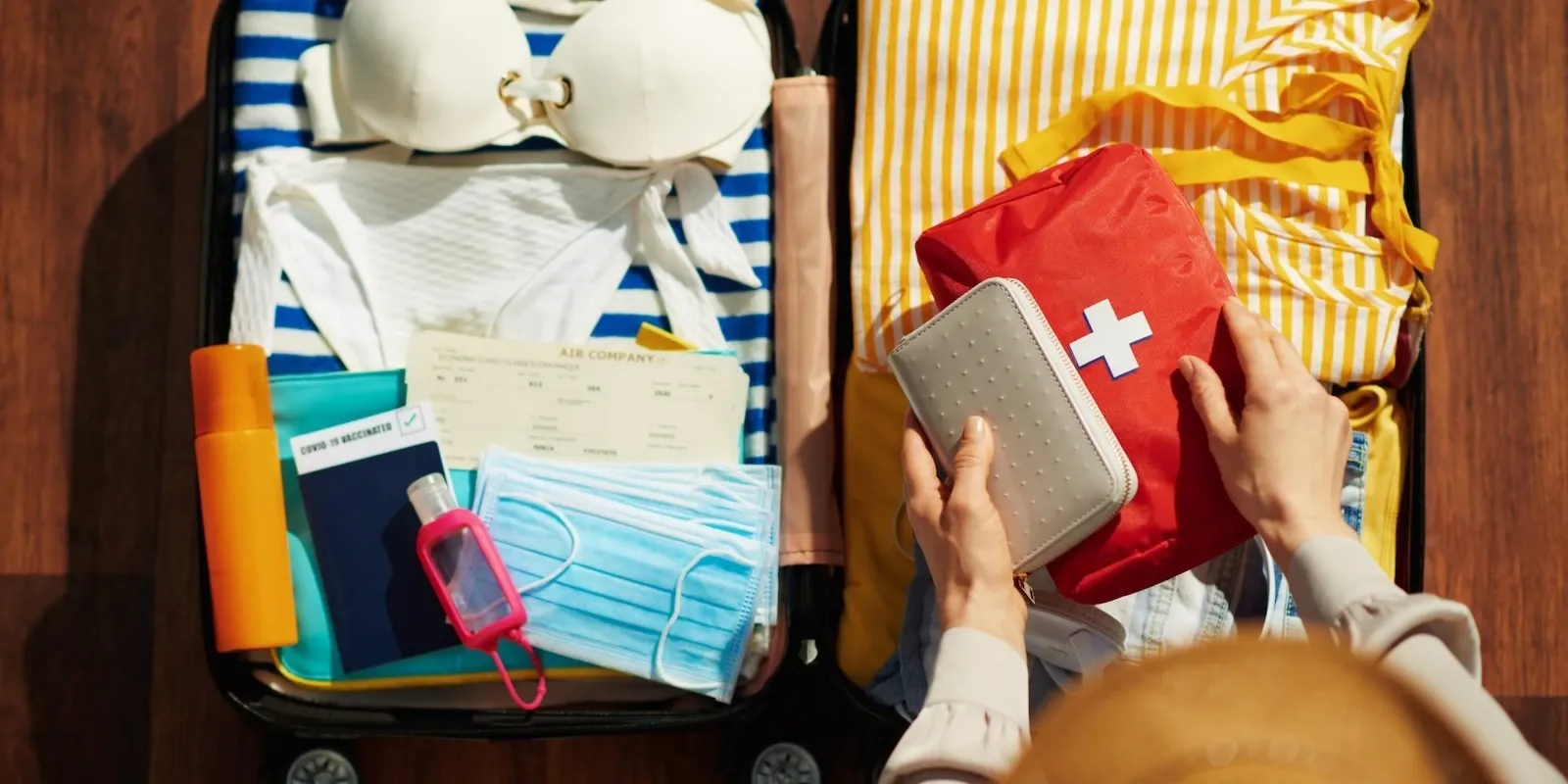
Medication on the plane: where to pack it
Essential medicines must always travel in carry-on baggage, never in checked luggage alone: beyond the risk of delayed or lost baggage, the cargo hold can reach very low temperatures during flight, dangerous for medicines like insulin that require constant refrigeration.
Liquid medicines over 100 ml: the documentation you need
Indispensable liquid medicines, typical of chronic or specialist therapies, can exceed 100 millilitres in the cabin, but must be declared separately at security along with a recent medical prescription or a letter from your doctor, ideally written within the thirty days before travel. Presenting it spontaneously, before being asked, speeds up the process; for international travel it's worth having it in English too, since a document written only in Italian may not be understood by staff at a foreign airport.
Medical devices, syringes and glucose monitoring sensors
Syringes and needles for daily injectable therapies, as in diabetes, require the same medical documentation to justify transport in the cabin. Continuous glucose monitoring sensors should be notified in advance, as some full-body scanners may temporarily interfere with their operation: it's worth checking with the manufacturer before your flight. Anyone who depends on an insulin pump or sleep apnea device should inform the airline in advance through the special assistance service; for more expensive devices, a travel insurance policy can cover loss or damage beyond standard baggage limits.
Medicines legal in Italy, prohibited elsewhere
Some over-the-counter medicines in Italy are controlled substances or completely illegal elsewhere, even with a valid regular prescription. In the United Arab Emirates codeine is classified as a controlled narcotic (Federal Law No. 14 of 1995): anyone carrying it should have a valid prescription and, ideally, prior approval from the Emirati Ministry of Health. In Japan, medicines containing codeine are not permitted, and the same applies to some decongestants with pseudoephedrine used for allergies and sinusitis. Verifying this aspect with the embassy of your destination country before departure avoids serious customs complications.
Time zones, extra supplies and active ingredients
Anyone crossing multiple time zones should plan with their doctor how to adapt dosing times for medicines more sensitive to timing, like certain hormone treatments. For those with severe allergies or diabetes, asking your doctor for a quantity slightly higher than necessary covers potential delays or trip extensions. Finally, keeping a list of active ingredients and not just brand names makes both emergency purchases at a local pharmacy and communication with a foreign doctor easier, since the same medicine can have completely different brands from one country to another.
Before international travel with medicines containing codeine or other controlled active ingredients, check the regulations of your destination country on the local health ministry website or embassy site: as the United Arab Emirates and Japan demonstrate, what is over-the-counter in Italy can be illegal elsewhere even with a valid prescription.
You might also like...

Kansas City International Airport: where to stay, areas and recommended hotels
What to always check on your boarding pass
Presidente Juscelino Kubistschek International Airport: where to stay, areas and recommended hotels

Phoenix Sky Harbor lounges: which to choose and where

Checked luggage: tricks to avoid it getting lost