Power banks on planes: what to know before you leave
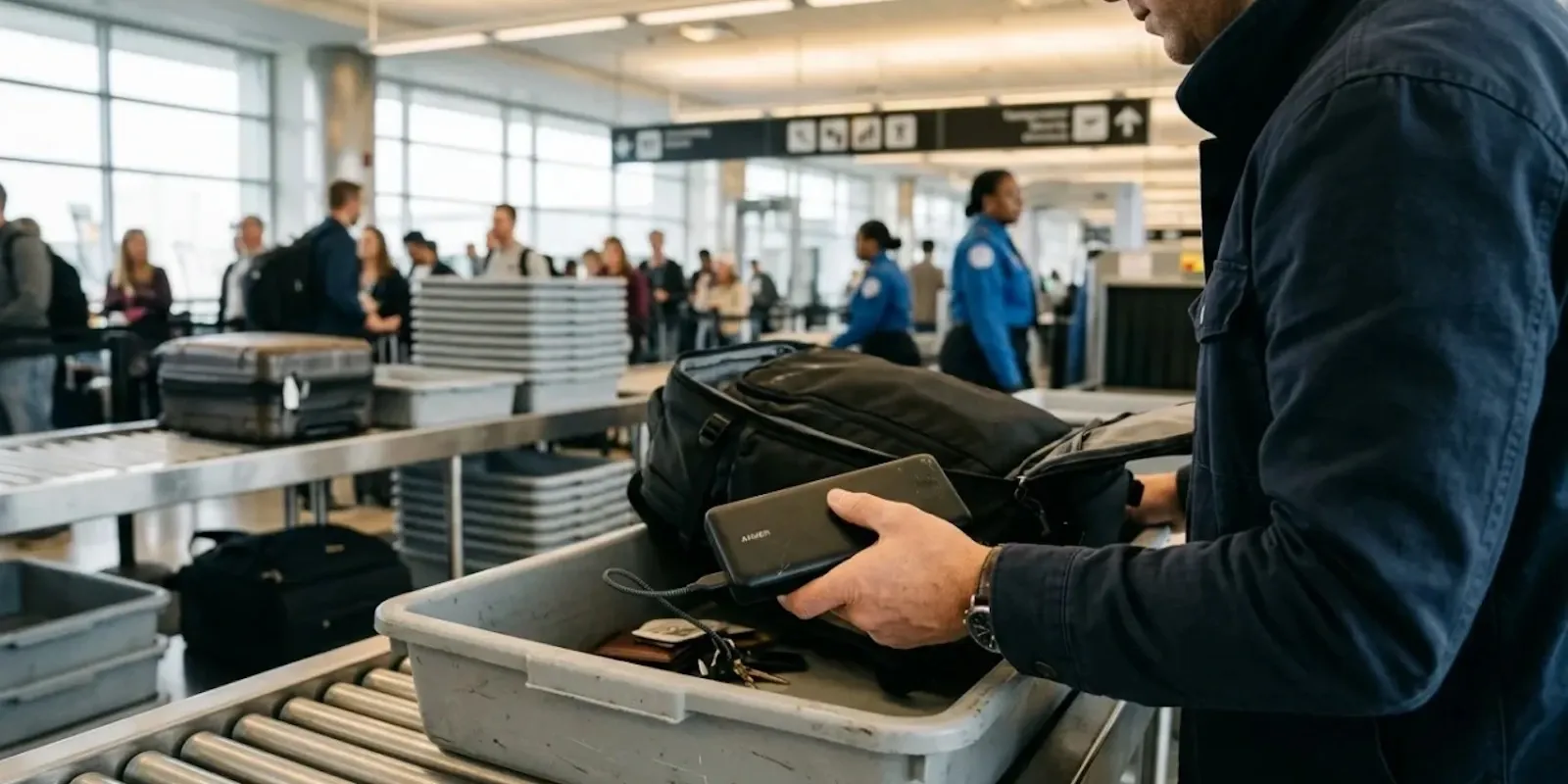
The general limit for bringing a power bank on a plane is 100 watt-hours with no authorization needed, with a ceiling of 160 watt-hours if the airline approves it in advance.
Watt-hour capacity limits
Up to 100 watt-hours (Wh) transport is free for most airlines; between 100 and 160 Wh you need airline authorization, usually requested when booking or checking in; over 160 Wh the power bank is not allowed even in carry-on baggage. When the watt-hour value is not printed on the label, calculate it by multiplying milliamp-hours (mAh) by voltage and dividing by 1000.
Carry-on baggage only, never in checked luggage
The power bank, like any loose lithium battery, must always go in carry-on baggage: if overheating or a short circuit occurred in checked luggage, it would be undetectable and unmanageable during flight. The rule applies to power banks integrated into other accessories too, such as suitcases with built-in USB charging.
How many batteries and what X-rays check
Many airlines limit two units per passenger for power banks in the 100-160 Wh range, but the exact number varies by carrier and it's best to check on the airline's website before departing. A power bank with visibly damaged, swollen, or deformed casing can be confiscated at security, regardless of the declared capacity. Those needing to charge multiple devices once in the airport can refer to our guide to charging zones in terminals.
Before packing, check the watt-hour value printed on the power bank: if it's missing or illegible, it's better to leave it at home or replace it, because at security checks no one will be able to verify it for you.
You might also like...

Béziers-Vias Airport: where to stay, areas and recommended hotels
Travel apps: your technology in your pocket

San Sebastian Airport: where to stay, areas and recommended hotels
Documents for traveling abroad without surprises
Mauritania Airlines: Fleet, Routes and the Carrier's Operational Problems