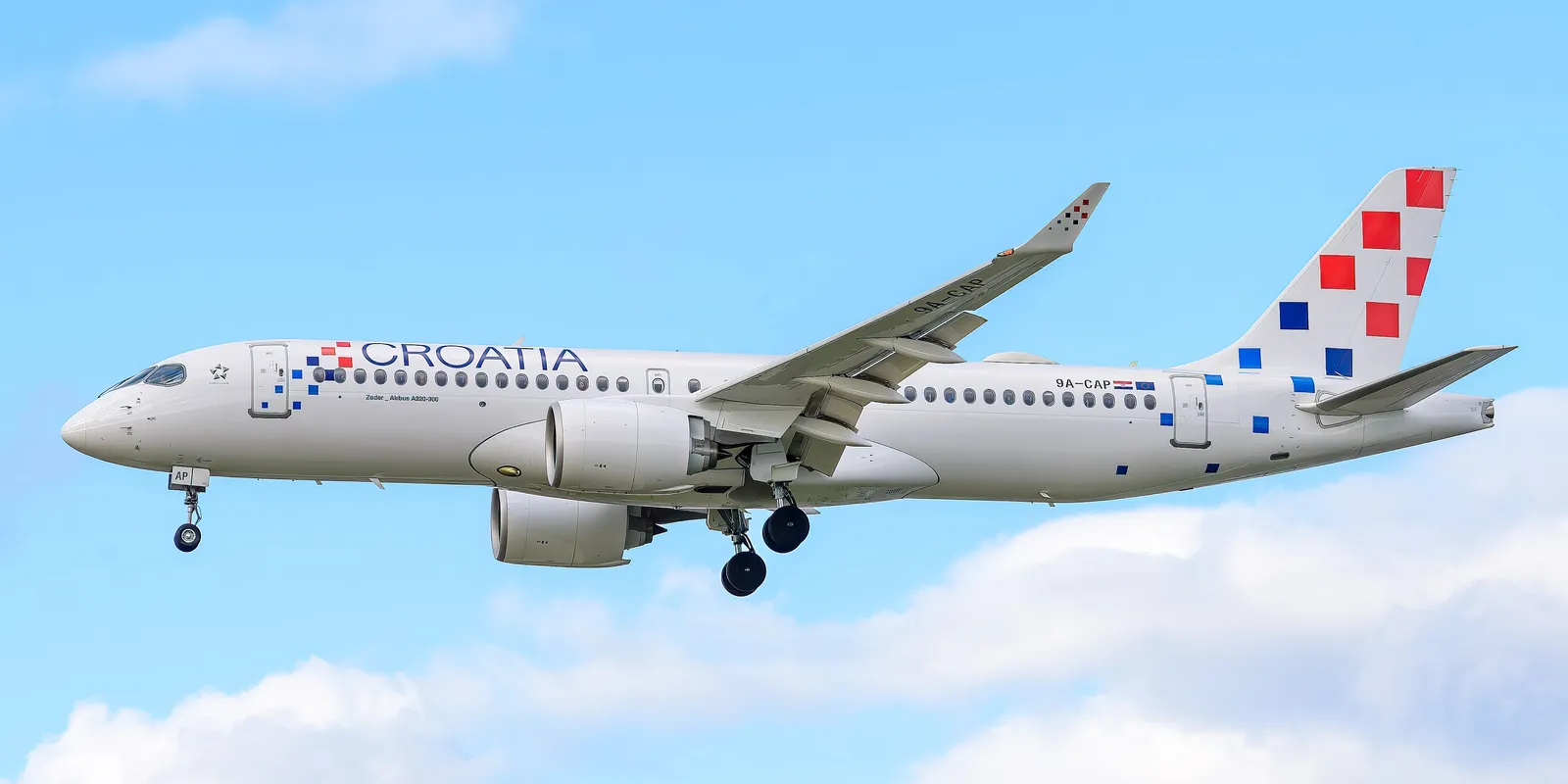
Croatia Airlines: The Airbus A220 Fleet and What Passengers Really Say
Croatia Airlines was founded in 1989 in Zagreb as Zagal, renamed the following year with its current name. It is 99.64% owned by the Croatian state and has its main hub at Zagreb airport, with seasonal bases in Dubrovnik, Split and Zadar. A member of Star Alliance since 2004, it links Croatia mainly with Frankfurt, Paris, London, Amsterdam, Berlin and Munich, as well as a dense regional network to the Balkans and Central-Eastern Europe.
A flag carrier with ups and downs
For decades Croatia Airlines has operated as the reference carrier of a country that lives off seasonal tourism, with traffic heavily concentrated between May and September toward the Adriatic coast. Its results have swung between profit and loss several times: after a 2023 that closed in the black with a net profit of €2 million, the airline returned to the red in 2024 and 2025, a sign of how fragile margins remain for a carrier of this size. It nevertheless remains the only direct air link between many European cities and Croatia in the off-season, when charter operators withdraw.
The fleet changeover under way
The airline is replacing its now-dated Airbus A319s with more fuel-efficient Airbus A220s: it currently operates 11 (2 A220-100s and 9 A220-300s) alongside 4 A319s still in service and 2 Dash 8-Q400s on the shortest regional routes. Another 4 A220s are on order, with the aim of completing the transition by 2027. Anyone booking today therefore has a good chance, especially on the main European routes, of already flying on the new aircraft rather than the old A319.
A network built for European links
Zagreb remains the central node, but in the summer months Dubrovnik, Split and Zadar become full operating bases with direct links to several German, French and British cities, without going through the capital. Star Alliance membership makes onward connections to the rest of Europe and overseas convenient with the alliance's partners, a concrete advantage for those arriving from outside Europe who need to change planes.
On board: two classes, no surprises
The cabin is divided into economy and business, the latter available on the main routes with an increased number of seats and more polished onboard service. The loyalty program is the same as Lufthansa's and the other Star Alliance members', Miles & More, useful for those who also earn miles on other alliance airlines.
What passengers say
Often-cited points:
- Punctuality perceived as above the European average on routes to Germany.
- Cabin crew described as professional, even on short, crowded flights in high season.
- Convenience of the direct seasonal links from Dubrovnik and Split, with no stop in Zagreb.
Recurring limitations:
- Prices that rise noticeably in the peak summer months on routes to the coast.
- A fleet that is still mixed, with some flights operated on the old A319s, less comfortable than the new A220s.
- A network of direct destinations more limited than that of the big neighboring flag carriers.
Croatia Airlines is the most sensible choice for those who need to reach Zagreb or the Croatian coastal cities in the low season, when charters do not fly, or for those who want to take advantage of a Star Alliance connection to Central Europe. It is less suitable for those looking for the lowest possible fare in the height of summer to Dalmatia, where seasonal charters often cost less for the same convenience.
If possible, when booking the main European routes, check the aircraft type at the time of booking: with the fleet still mixed between A319s and A220s, consciously choosing the flight operated on the new aircraft makes a concrete difference in cabin space and noise.
You might also like...

Hammerfest Airport: where to stay, areas and recommended hotels

Modlin Airport: where to stay, areas and recommended hotels
ITA Airways in 2026: The New Fleet, the Move to Lufthansa and What Passengers Really Say

Flight delay: what changes at each time threshold

Jeju lounges: Korean Air or Asiana, how to choose