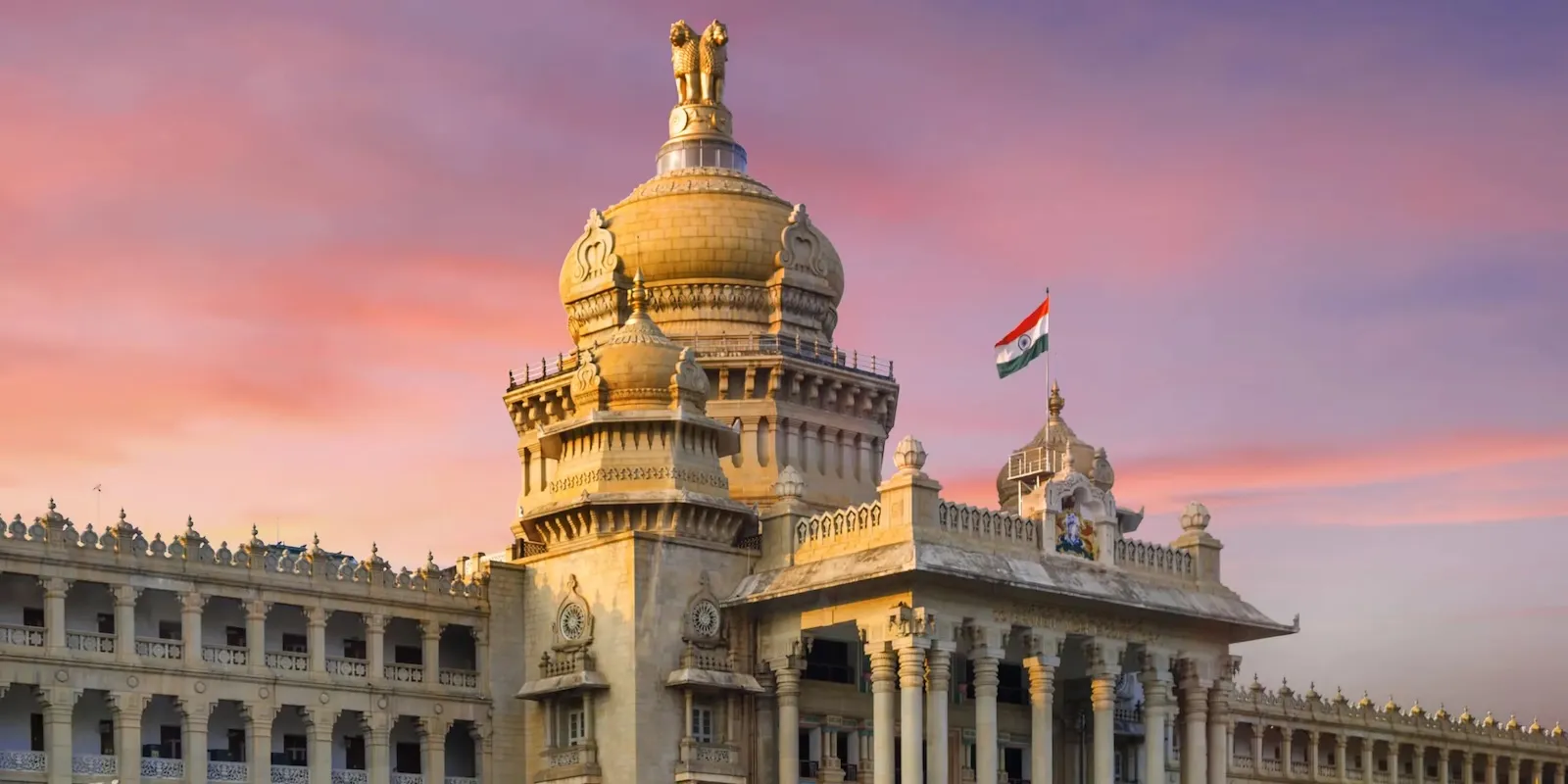

Bangalore between gardens and royal palaces
The tech capital of India, Bangalore preserves beneath the traffic and software skyscrapers the soul of a "garden city," envisioned by the Mysore maharajas who governed it for centuries.
The distances between neighborhoods require a tuk-tuk or car for much of the day.
Lalbagh Garden, more than two hundred acres commissioned in the eighteenth century by the sovereign Hyder Ali and later enlarged by his son Tipu Sultan, hosts one of Asia's oldest glass and iron greenhouses, still today a venue for biennial flower exhibitions.
Bangalore Palace, built in 1887 in Tudor revival style inspired by Windsor Castle, still belongs to the Mysore royal family and opens some rooms to the public among original furnishings and hunting trophies.
Cubbon Park, three hundred acres of green in the heart of the colonial city, connects various government buildings in Indo-Saracenic style, including the state library and the High Court of Karnataka.
The ISKCON temple, on Hare Krishna hill, combines traditional dravidic temple architecture with modern glass and steel elements, with a golden dome visible from much of the city.
A palace inspired by Windsor and a Hare Krishna temple in glass and steel tell two opposing impulses of the same city: looking to colonial Europe on one hand, reinventing Hindu tradition on the other.
Lalbagh, older than both, remains the fixed point around which Bangalore has continued to redefine itself without ever destroying it.
Guided tours and experiences in Bangalore


Related articles

You might also like...
Kozhikode: where Vasco da Gama landed in India
Chennai: the gateway to South India

Neos: The Alpitour Group's Leisure Airline and Its Intercontinental Routes

Kenn Borek Air: The Airline No Tourist Books but Every Polar Pilot Knows

Soummam Airport: where to stay, areas and recommended hotels