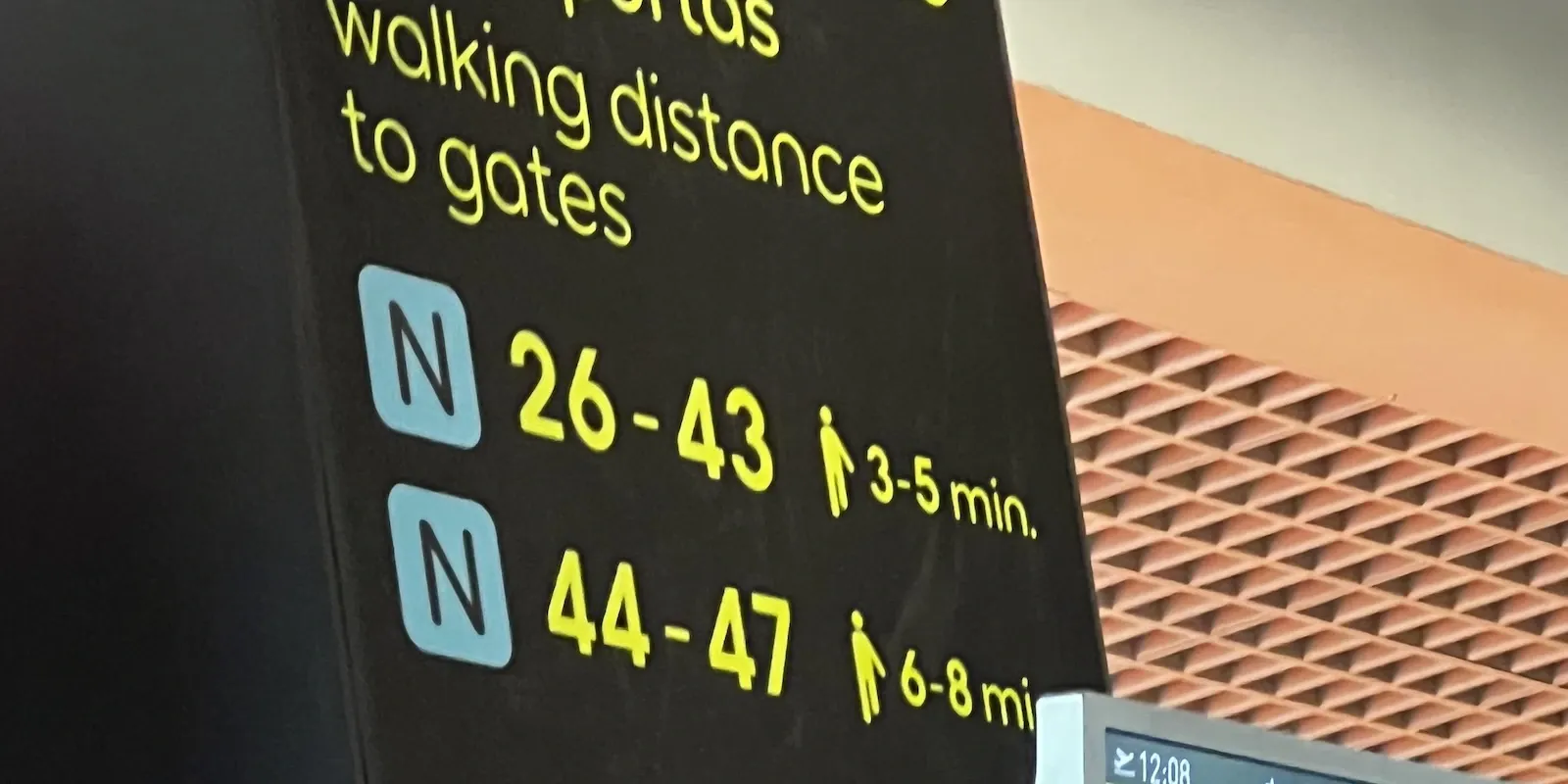
How long it takes to reach the gate
At major international hubs, the distance between security checkpoints and the furthest gates can require over 20-25 minutes of continuous walking, a time that at regional airports reduces to just a few minutes. Calculating this margin realistically, rather than relying on generic estimates, prevents the last-minute rush through airport corridors.
Airport size and internal transportation
The factor that weighs more than any other is the size of the airport: at a regional airport, security screening might be just minutes from any gate, while at major hubs, the distance between the furthest gates often requires 20-25 minutes of walking. It's no coincidence that airports like Atlanta, Denver, or Dallas-Fort Worth built an automated internal train (people mover) precisely to eliminate walks of this duration: at Atlanta the system connects eight stations over nearly 4.5 kilometers, at Denver it connects the main terminal to concourses A, B, and C. If your airport has such a system, the waiting time at the platform should always be added to your calculation, not subtracted from the walking time.
Additional checkpoints and unscheduled stops
An additional security or passport checkpoint along the route, typical of non-Schengen flights at many European airports or for those changing areas during a layover, introduces unpredictable time that must be estimated separately from simple walking. Even a quick stop for food or a purchase at the duty-free consumes real minutes and should be factored into your total available time, not treated as free time.
Physical fitness, baggage, and connections
Families with children, passengers with reduced mobility, or those carrying heavy baggage take longer than average times mentioned by ground staff, which generally assumes a passenger without impediments moving at a brisk pace: that estimate should be treated as a minimum, not a comfortable one. For those with a connection, the calculation becomes more complex because the arrival point can be far from the next gate, especially at major hubs where domestic and international flights operate from separate areas: the article on how much time is really needed for a connection goes into detail on this specific calculation.
Use official information instead of guessing
Once the gate is known, official airport apps and displays along the route often show the estimated travel time calculated for that specific distance: this is more accurate than any estimate based on experience at different airports. Adding roughly a quarter more to that number covers most minor unexpected delays, from stops for restrooms to final goodbyes with those seeing you off.
Once you know the gate, check the estimated travel time on the airport app or displays along the route and add roughly a quarter more to that figure: it's a margin that covers practically any minor setback without arriving an unnecessarily full hour early.
You might also like...

Diagoras Airport: where to stay, areas and recommended hotels

Sangster International Airport: where to stay, areas and recommended hotels
Living the airport: tricks to navigate the terminal

How to behave at the airport from departure to boarding

Sleeping at the airport: how to find quiet corners