Thai Airways After the Restructuring: The Changing Fleet and the Return to Profit
Thai Airways International was born in 1960 as the international arm of the Thai flag carrier, founded together with Scandinavia's SAS to launch long-haul services, and in 1988 it absorbed the domestic Thai Airways Company, becoming the country's sole carrier. Its main hub is Bangkok-Suvarnabhumi, from which a network spreads that covers 64 destinations in the winter season. A founding member of Star Alliance since 1997, the airline positions itself as a traditional full-service carrier, with a recent history marked more by financial recovery than by growth.
History and positioning
The most important chapter of recent years is the reorganization procedure opened in May 2020 before the Thai bankruptcy court, in the midst of the pandemic crisis: thousands of redundancies, the sale of aircraft and the suspension of dozens of routes drastically reduced the carrier's size. The recovery plan formally ended in September 2024, with its exit from the insolvency procedure and the stated goal of returning to the stock exchange. Since then Thai Airways has aimed to grow again, but from a much smaller base than before the crisis.
The fleet
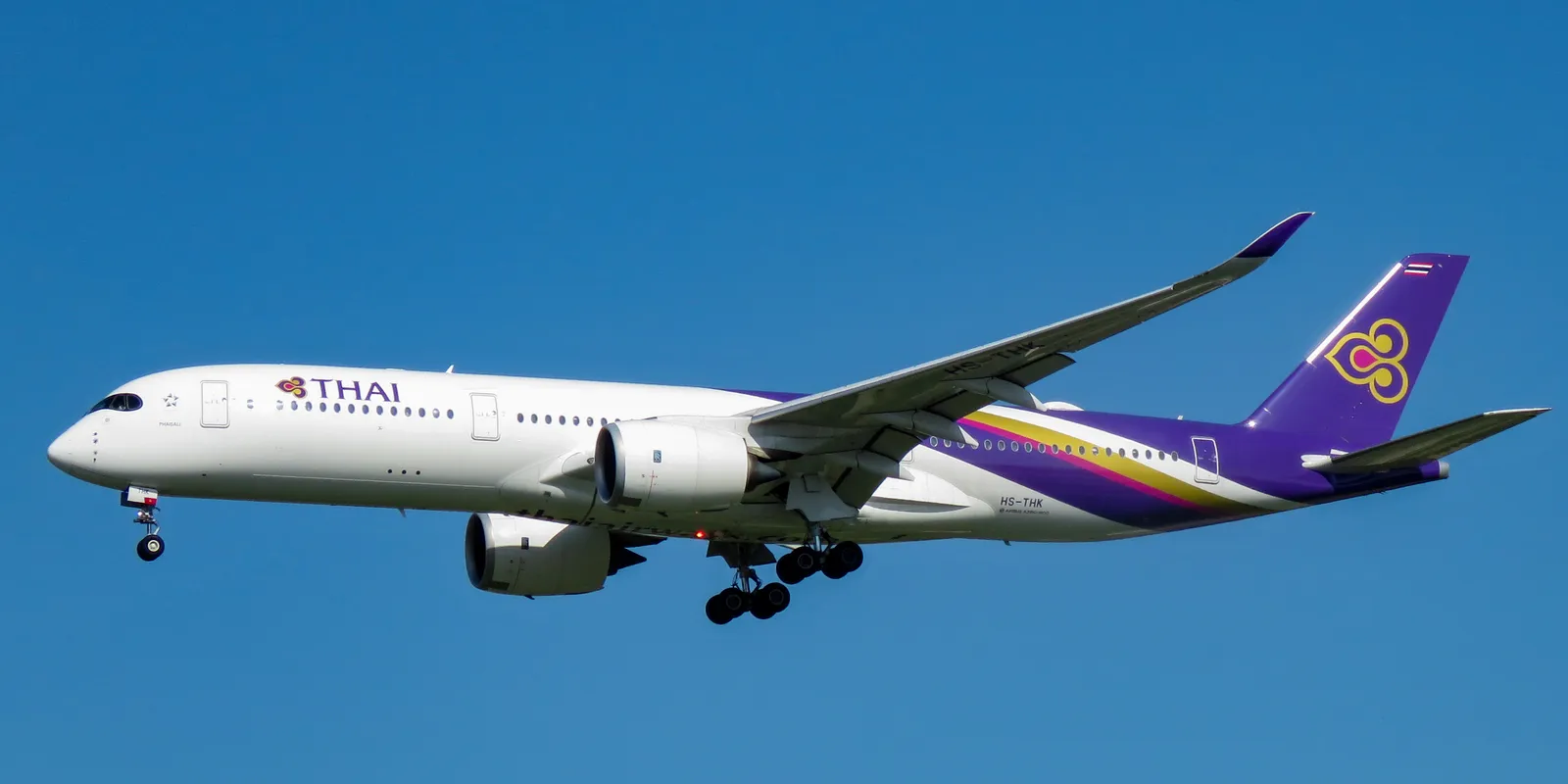
The fleet combines Boeing 777-200 and 777-300, Boeing 787-8 and 787-9 and Airbus A350-900 aircraft, with the aim of reaching about 90 aircraft by the end of 2025, compared with 79 at the start of the year. The old 777-200ERs are expected to leave the fleet by 2026, while a firm order has been signed for 45 new Boeings with deliveries starting in 2027. The A350s and 777-300ERs will also receive new Royal Silk and Economy cabins in the coming years, with Economy Plus restored on some aircraft.
Routes and network
From Bangkok the network spreads across Europe, Oceania and much of Asia, using Star Alliance codeshare agreements for intercontinental connections. The airline has brought back into its own structure the regional routes it previously ran through its subsidiary Thai Smile, aiming for a more coherent offering to short- and medium-haul destinations in Southeast Asia alongside the major long-haul links to Europe.
On board and service
The cabins available are Royal Silk Business and Economy, with First Class now residual on only a few aircraft. Onboard service remains one of the brand's historic strengths, with carefully prepared Thai cuisine and an attention to detail in hospitality that predates the recent financial crisis by decades.
What passengers say
Skytrax rates Thai Airways among its 4-star carriers, a level maintained even during the restructuring years.
- Recurring praise: quality of cabin service, onboard cuisine, comfort of the Royal Silk seats on the newest aircraft.
- Criticisms: average age still high on part of the fleet awaiting the announced refurbishments, and a network reduced compared with the pre-pandemic period on some minor European destinations.
Thai Airways suits those looking for a direct long-haul flight to Bangkok with traditional cabin service and who are in no hurry for tightly timed connections during the network's growth phase. It is a less suitable choice for anyone who must book far in advance counting on wide availability of premium seats, since the fleet is still being rebuilt after the 2020 cuts. Before flying on secondary European routes, it is worth checking whether the flight is operated directly or through a Star Alliance partner, because the network is in the middle of a reorganization.
You might also like...

New York JFK: how to navigate arrival in the Big Apple

Chișinău International Airport: where to stay, areas and recommended hotels
Canadian North After the First Air Merger: How It Flies Today
Bangkok Airways: The Airline That Owns Its Own Airports

Sir Seewoosagur Ramgoolam International Airport: where to stay, areas and recommended hotels